

Management Proverbs / That Was When You Were A Prospect
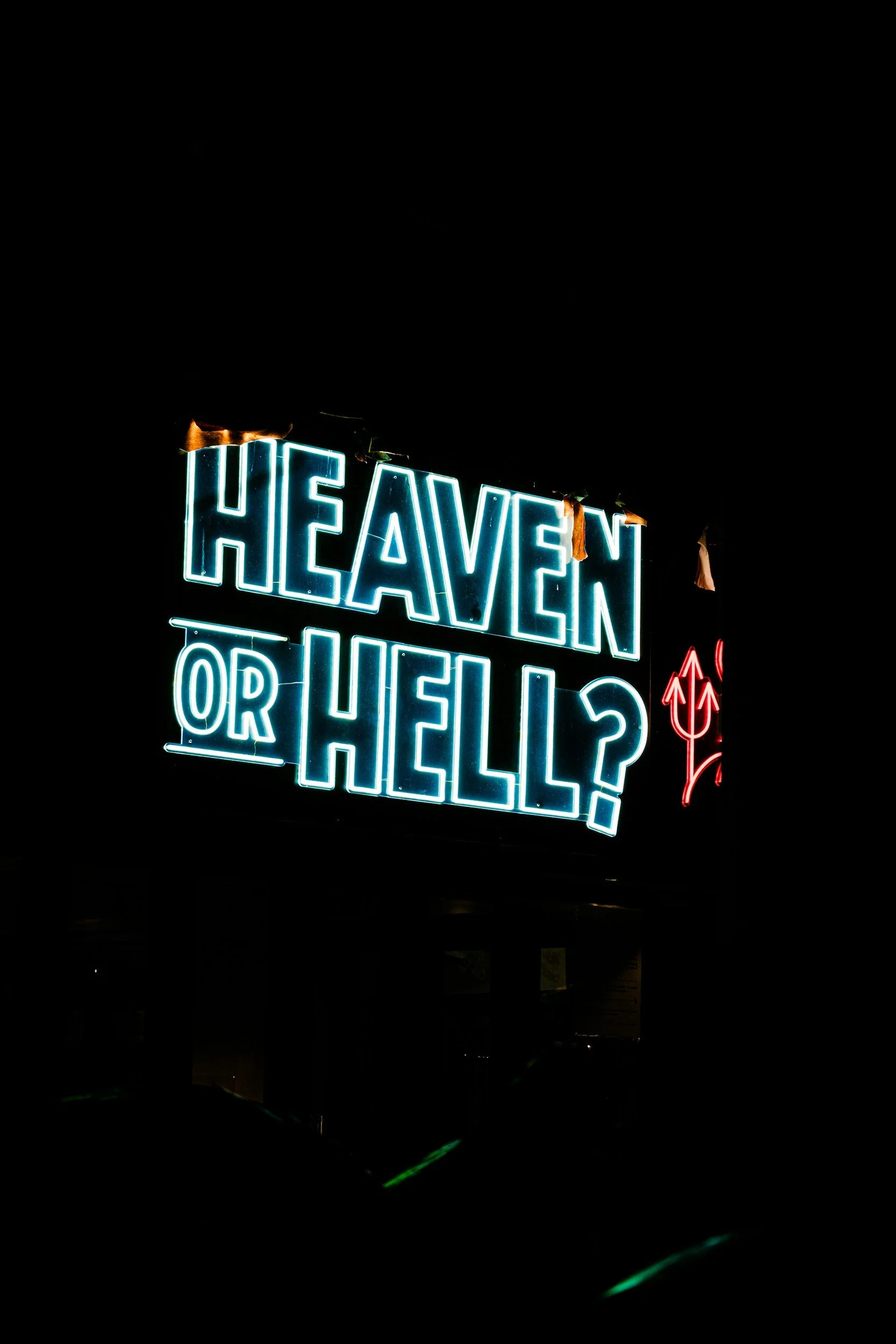
Mr. Frank--a partner at Dewey, Cheatham and Howe—tragically dies of a coconut wound to the head while vacationing in Bora Bora. Taken immediately to the Pearly Gates, he runs into St. Peter and Lucifer.
St. Peter says, “Um, Mr. Frank, you’ve kind of—how shall we say this—been naughty and nice. As a result, you have a choice. You can either come into heaven or go to hell with Lucifer here. Would you like a preview of how your everlasting life will be in each place?”
“Sure,” says Mr. Frank. “Let’s check out heaven first.”
St. Peter assigns an angel—typical deal: white robe; wings; cherubic--to guide the future customer through heaven. The angel and Mr. Frank enter through the Pearly Gates and head up a cloud shrouded staircase. When they get to the top of the staircase, Frank sees men and women sitting on clouds, dangling their feet off the edge, some playing lyres, others recorders. Some are reading. It is beautiful and sunny and peaceful. Everybody is smiling and happy. “That’s it?” Frank asks. “That’s it, Mr. Frank,” the angel replies. “Beautiful and peaceful, isn’t it? Would you like to see...” the angel asks. Frank cuts the angel off, “No, no. I think I get it. Now what about hell?”
Lucifer sends the metaphysical equivalent of a super model, with wings, of course, to meet Mr. Frank at the base of the staircase. She happens to be carting a tray of perfect Manhattans. “My name is Sabrina. No teenage witch cracks, please. It gets old after an eternity or two. Anyway, would you like a cocktail, Mr. Frank?” asks Sabrina. “Well, that sounds promising. Sure, I will take a Manhattan.”
Sabrina and her prospect descend a gold and diamond studded escalator. “Nice touch, the diamonds, ” Frank comments. When they get to the bottom, Frank looks around and sees people drinking martinis, dancing, a disco ball spins. Smoke. Lasers. The whole megillah. Frank could do without the disco ball. To his left, he sees a travel agent scheduling trips to exotic resorts. “Hey, that’s Bora Bora,” shouts Frank. With a Vegas style casino in the distance on his right. Mr. Frank is torn. But, then, Bora Bora didn’t work out so well the last time.
After Frank has a Manhattan or two and checks things out, wins a couple of bucks at the casino—the attractive croupier winks a him as he leaves—they reconvene with St. Peter and the cherub, who eagerly await Mr. Frank’s decision. “Have you made up your mind, Mr. Frank?” St. Peter asks. “Yes, I have,” Frank replies. “As nice as heaven is, I have to choose hell. More my speed and heaven seems, well, to be honest—I am being honest about this at this point; why not--a little boring.” “OK,” St. Peter replies. “Have a nice everlasting life.”
Frank grabs another Manhattan and says to Sabrina, “Let’s get this party started.” He follows Sabrina down the fancy, schmancy escalator. When he gets to the bottom, Sabrina pushes him off and he finds himself in a big pit, engulfed in flames. People are screaming, moaning, wailing, pleading for mercy. Lots of smoke. Lightning strikes here and there.
Lucifer, he is the one with the pitchfork and horns, approaches Frank and says, “Welcome to hell.”
“Wait. Wait. What happened to Sabrina, the Manhattans, the travel agency, the party?”
Lucifer gives Frank a big, devilish grin—you expected something else?--and slaps him on the back. It hurt. “Well, Mr. Franco,” Lucifer said. “That was when you were a prospect. Now, you are a customer.”
An old joke, yes. But it is no joke when businesses treat prospects and customers differently. Yet, it happens all the time. Nothing could be stupider.
In a twisted way, poor sales and service practices are a blessing to properly managed small businesses. In the absence of some compellingly unique value proposition, customers change providers when two basic circumstances exist: 1) The customer must have a reason to move to a new provider; and 2) The customer must have a reason to leave the existing provider.
Over my forty plus year career, nothing sounded sweeter than hearing that my competition was ignoring, mistreating, or making mistakes with a prospect I was trying to woo away. It does not make converting the prospect into a customer super easy. Afterall, there are other competitors out there. But it does make it possible. It creates an opening. An opportunity. (By the way, just keep calling on the prospect. The incumbent will screw up eventually.)
So how should you treat customers to make sure you do not give them a reason to leave? You should treat them like your most valuable asset. Why? Because they are. And I don’t want to hear the lame excuse that you can’t afford to; that treating them the same costs too much money. Or we are too busy bringing in new business. Or that the incentive program is messed up. Whatever the BS reason might be. It’s a simple equation: No customers = no sales = no employees.
That means you still take them to the big football game, like you did before they moved their business to you. That means you still visit with them 4-6 times a year, like you did before they became your customer. That means you and your staff ask them—in those quarterly meetings—how’s it going and is there anything else we can do. And It means you, the big kahuna, still meet with them from time to time and don’t make lame excuses either and pawn the responsibility off. Which Italian restaurant do you typically like best? The one where you never see the owner? Or the one where Giuseppe walks around and asks how’s the food? It’s no different. You’ve gotta show up. Most importantly, your company needs to have a customer focused culture from the top—that’s you—that spreads through the entirety of the staff. You have to hire for it, pay for it, manage to it, reward for it.
Let me give you an example of how not to do it.
I wanted to hand-out coffee cards to my students as spot awards for doing extraordinary things. I went to the on-campus store to see what I could do. They didn’t sell them there but said I could get them at the other store which was quite a drive from the campus. Most kids couldn’t get there easily. I buy well over $100 worth of the cards and take one to the on-campus store to make sure it would work.
Turns out, they didn’t work. Ok. No big deal. I just return them and go to Plan B—another management proverb. The barista in charge said she’d bring it up at the Thursday staff meeting and the owner would call me back. So, I didn’t return them right away. Well, Thursday came and went, no call. I went back to the campus store again. “We’re so sorry. We will bring it this Thursday, I promise.” This happened at least three times. Crickets. I will go to the original location and take them back BUT a month or more has passed while I was waiting to figure out a way to work this out with the company. Regardless, there is a competitor on the campus—not as good but less expensive—and that is where I will go from now on. And they don’t have gift cards!!!
In the case of my coffee shop, there wasn’t the prospect promise, customer disappointment scenario as is the case of Mr. Frank. But the principle is the same and it illustrates the impact poor customer service / attention has on retention and prospective sales.
The proverb, told in the fashion of the old “That Was When You Were a Prospect” joke, teaches an indispensable lesson in customer service. So, treat your customers like prospects. If not, the joke will more than likely be on you. And you won’t find that very funny.
Show A Little Faith.